PlantPredict
Platform Upgrade: Migration to .NET 8
As part of our ongoing platform modernization, PlantPredict’s calculation engine has been upgraded from .NET Framework to .NET 8 — the latest long-term support release from Microsoft. This foundational upgrade delivers meaningful improvements to performance, security, and long-term supportability across the entire platform, and applies to all prediction logic versions. Users should experience noticeable performance improvements in UI page transitions, creating, cloning, and saving assets, and overall API responsiveness. No changes have been made to any prediction algorithms or calculation logic as part of this upgrade. All PlantPredict algorithms, formulas, and engineering models remain identical.
Technical Note on Floating-Point PrecisionThe .NET 8 migration changes how the CPU processes floating-point arithmetic at the hardware level. While all PlantPredict algorithms, formulas, and engineering models remain identical — no calculation methodology has been changed — this lower-level change can produce extremely small numerical differences in outputs. Terabase has performed several hundred prediction validations to ensure backwards compatibility, confirming that result deviations are less than 0.01%. These differences fall well within acceptable engineering tolerances and have no practical impact on energy yield predictions.
Bug Fixes & Improvements
- Map Builder Responsiveness — Fixed an issue where Map Builder could become unresponsive due to an invalid derate rating, ensuring a smoother and more reliable design experience.
- Company Default Validation — Added validation to prevent company-level defaults from being configured with invalid derate ratings, reducing the risk of downstream errors.
- Module Input Tooltips — Corrected erroneous tooltip messages for Module inputs, ensuring accurate guidance throughout the module configuration workflow.
Pro Tools
Terrain Pro
Features & Improvements
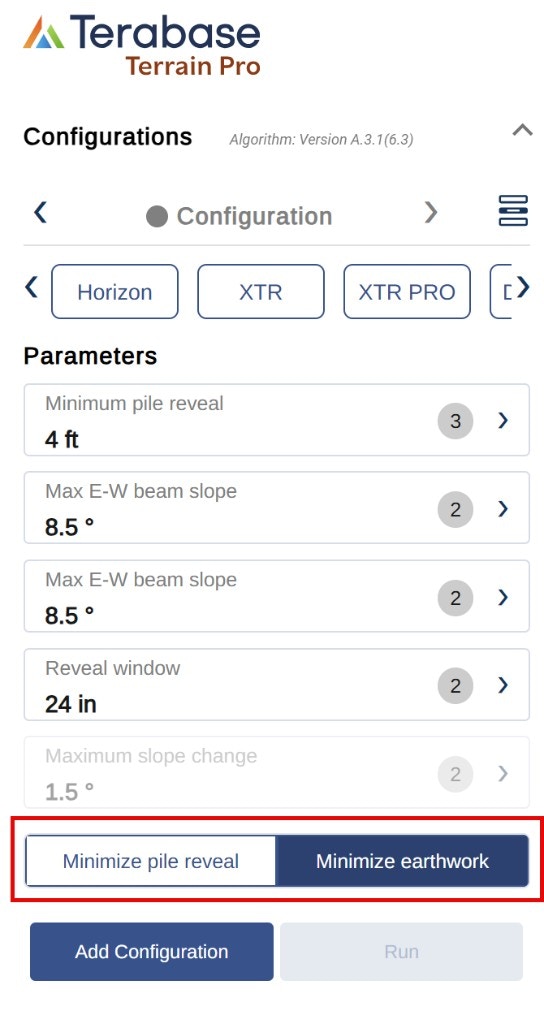
Optimization Objective Toggle — Earthwork vs. Pile Reveal
Users now have direct control over the optimization objective when running Terrain Pro analyses. A new toggle allows selecting between Minimize Earthwork and Minimize Pile Reveal, giving engineers the flexibility to tailor grading solutions to specific project priorities — whether that means reducing cut-and-fill volumes or optimizing pile exposure lengths. This replaces the previous automatic behavior that always defaulted to minimizing earthwork. The selected objective is applied across all supported algorithm versions (1.1–6.3), saved with the analysis, and clearly displayed in the UI, reports, and exports for full traceability.