A PlantPredict module file contains all electrical, physical, and optical parameters required to model PV module performance. Module files are organized across eight tabs, each containing related parameters.

Tab Overview

TabDescription
Physical & NameplateGeneral information, physical dimensions, and STC ratings
1-DiodeSingle-diode model parameters for I-V curve generation
ChartsRelative efficiency curves at multiple temperatures
SpectralSpectral response coefficients
MetastabilityMetastability parameters (experimental — Terabase Energy only)
ShadingModule shading response configuration
IAMIncidence Angle Modifier coefficients
Modeling DefaultsDefault loss factors, thermal parameters, and degradation settings

Physical & Nameplate Tab

The Physical & Nameplate tab contains general module information, physical characteristics, and Standard Test Conditions (STC) ratings.
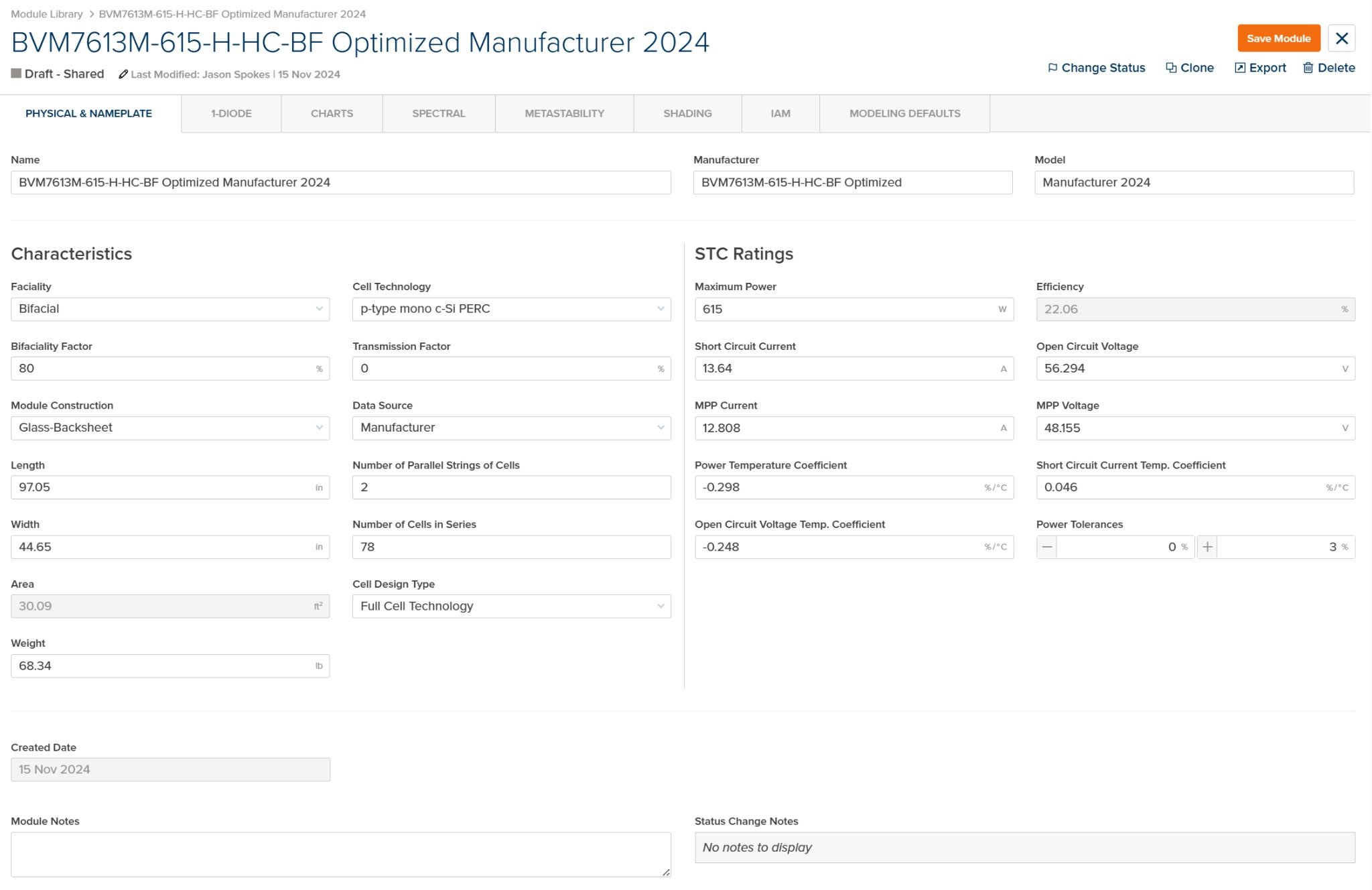
Module File Physical & Nameplate

Module File - Physical & Nameplate Tab

General

ParameterUnitsDescription
NameDisplay name for the module in the library
ManufacturerModule manufacturer name
ModelManufacturer’s model number

Characteristics

ParameterUnitsDescription
FacialityModule front/rear configuration. Options: Monofacial, Bifacial
Bifaciality Factor%Ratio of rear-side efficiency to front-side efficiency (bifacial modules only)
Module ConstructionConstruction type. Options: Glass-Backsheet, Glass-Glass
Lengthcm / inModule length
Widthcm / inModule width
Aream² / ft²Total module area (calculated)
Weightkg / lbModule weight
Cell TechnologyCell type. Options: n-type mono c-Si, p-type mono c-Si PERC, p-type mono c-Si BSF, poly c-Si PERC, poly c-Si BSF, CdTe, CIGS, Mixed
Transmission Factor%Optical transmission factor
Data SourceSource of module data. Options: Manufacturer, PVsyst, University of Geneva, Photon, Sandia Database, Custom, PlantPredict
Number of Parallel Strings of CellsCell strings wired in parallel
Number of Cells in SeriesCells wired in series per string
Cell Design TypeCell design configuration. Options: Full Cell Technology, Half-Cell Technology, N/A, None Specified

STC Ratings

ParameterUnitsDescription
Maximum PowerWRated power at STC (1000 W/m², 25°C, AM1.5)
Efficiency%Module efficiency at STC
Short Circuit CurrentAShort circuit current (Isc) at STC
Open Circuit VoltageVOpen circuit voltage (Voc) at STC
MPP CurrentAMaximum power point current (Imp) at STC
MPP VoltageVMaximum power point voltage (Vmp) at STC
Power Temperature Coefficient%/°CTemperature coefficient of power (negative value)
Short Circuit Current Temp. Coefficient%/°CTemperature coefficient of Isc (typically positive)
Open Circuit Voltage Temp. Coefficient%/°CTemperature coefficient of Voc (negative value)
Power Tolerances%Manufacturing power tolerance range (−/+)

Notes

ParameterUnitsDescription
Created DateDate the module file was created
Module NotesFree-form notes about the module
Status Change NotesNotes added when module status was changed (read-only)

1-Diode Tab

The 1-Diode tab contains parameters for the single-diode equivalent circuit model used to generate I-V curves at any irradiance and temperature condition.
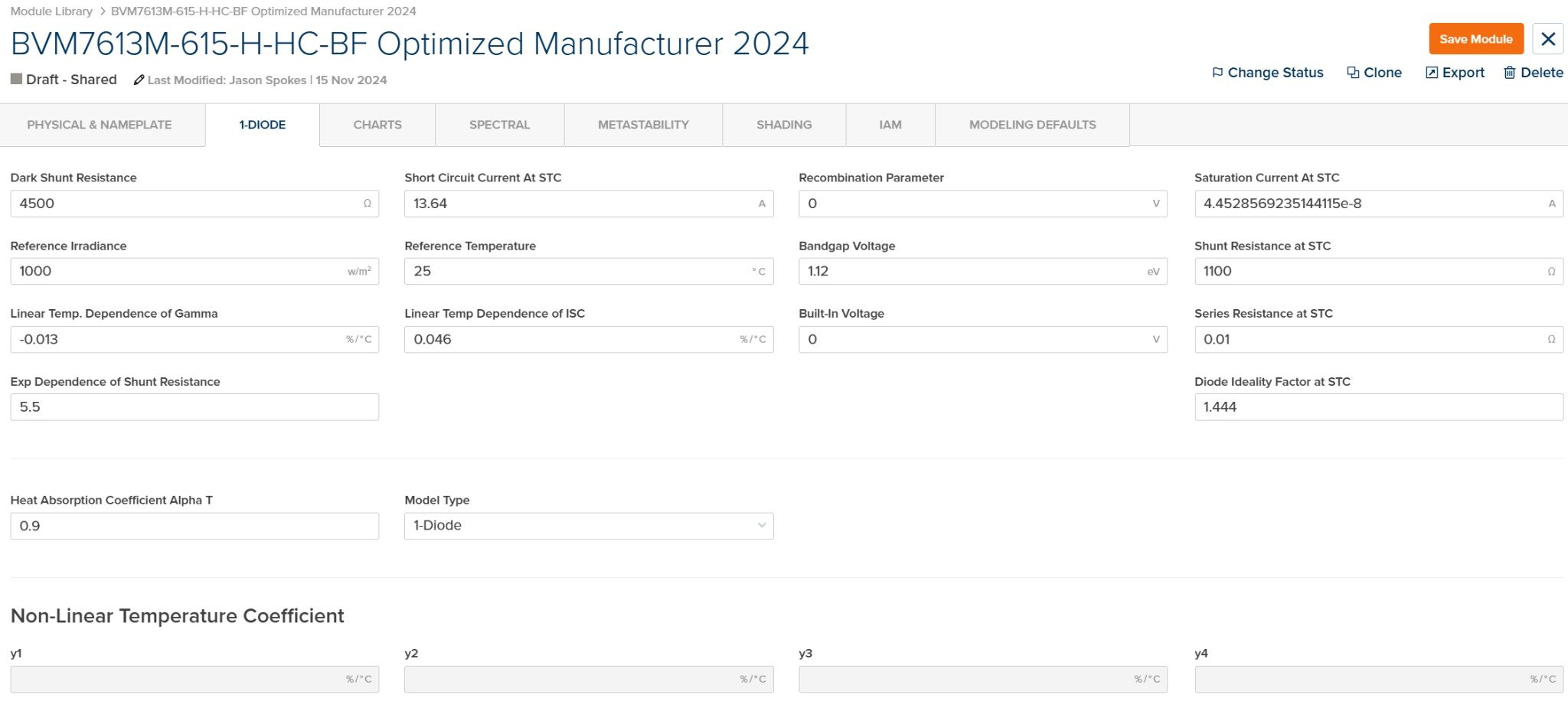
Module File 1-Diode

Module File - 1-Diode Tab

Single-Diode Parameters

ParameterUnitsDescription
Dark Shunt ResistanceΩShunt resistance in the dark
Short Circuit Current At STCAPhotogenerated current at STC
Recombination ParameterRecombination loss parameter
Saturation Current At STCADiode saturation current at STC
Reference IrradianceW/m²Reference irradiance for STC (typically 1000)
Reference Temperature°C / °FReference temperature for STC (typically 25°C / 77°F)
Bandgap VoltageeVSemiconductor bandgap voltage
Shunt Resistance at STCΩShunt resistance at STC
Linear Temp. Dependence of Gamma%/°CTemperature dependence of ideality factor
Linear Temp Dependence of ISC%/°CTemperature dependence of short circuit current
Built-In VoltageVBuilt-in junction voltage
Series Resistance at STCΩSeries resistance at STC
Exp Dependence of Shunt ResistanceExponential dependence of shunt resistance on irradiance
Diode Ideality Factor at STCDiode ideality factor at STC
Heat Absorption Coefficient Alpha THeat absorption coefficient
Model TypeDiode model type (1-Diode)

Non-Linear Temperature Coefficient

ParameterUnitsDescription
γ1, γ2, γ3, γ4%/°CPolynomial coefficients for non-linear temperature dependence
The single-diode model parameters are typically generated automatically when creating a module from datasheet values or I-V curves. Manual editing is available for advanced users.
See Single Diode Model for detailed algorithm documentation.

Charts Tab

The Charts tab displays relative efficiency curves showing module performance across a range of irradiance levels at different temperatures.
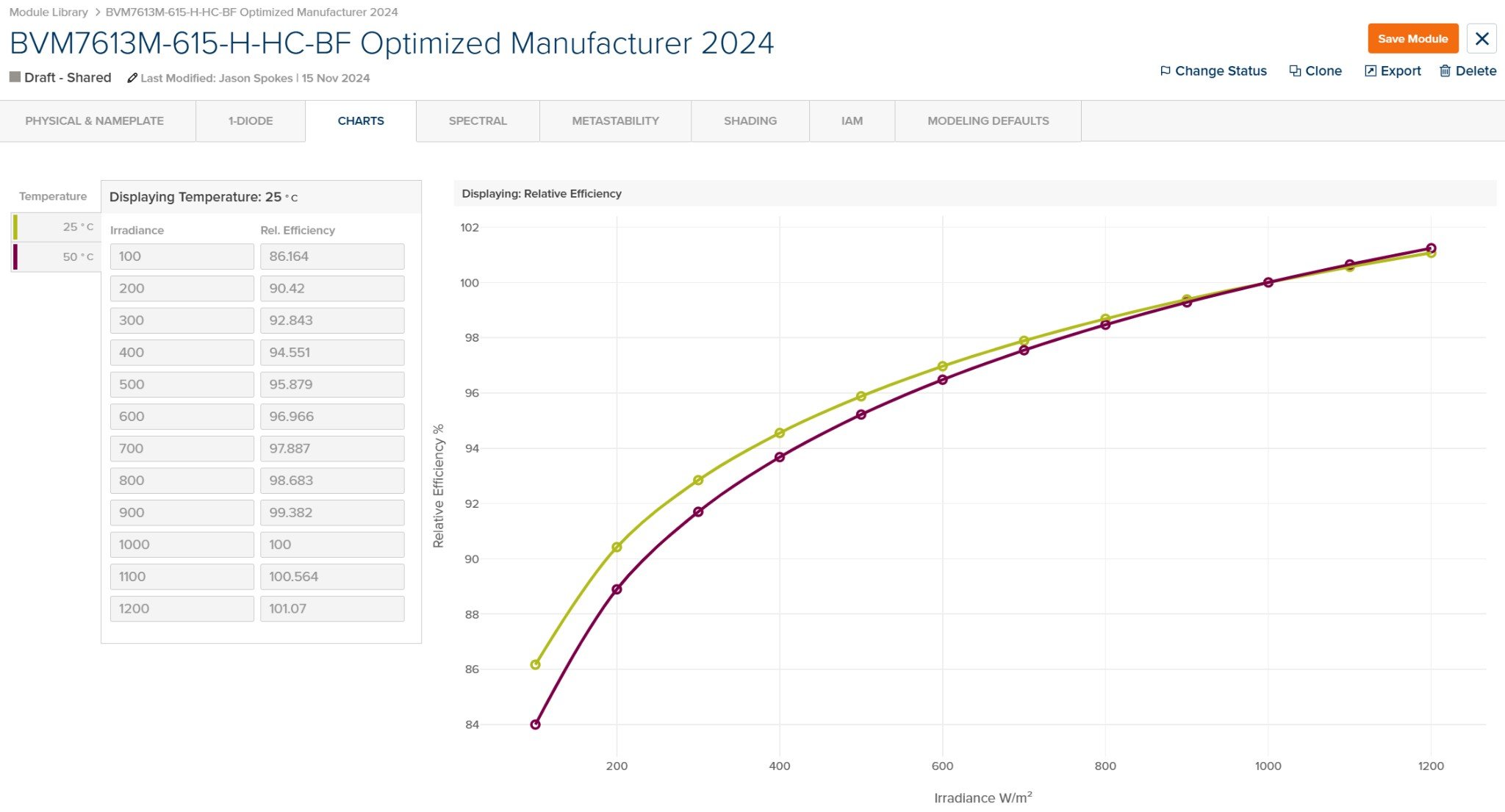
Module File Charts

Module File - Charts Tab

Relative Efficiency Data

ParameterUnitsDescription
Temperature°C / °FTemperature for the displayed curve (selectable: 25°C / 77°F, 50°C / 122°F)
IrradianceW/m²Irradiance level (typically 100-1200 W/m²)
Rel. Efficiency%Relative efficiency at each irradiance level (100% = STC efficiency)
The chart visualizes how module efficiency varies with irradiance, with separate curves for each temperature condition. Low-light performance (below 200 W/m²) typically shows reduced relative efficiency.

Spectral Tab

The Spectral tab contains coefficients for modeling the spectral response of the module under varying atmospheric conditions.
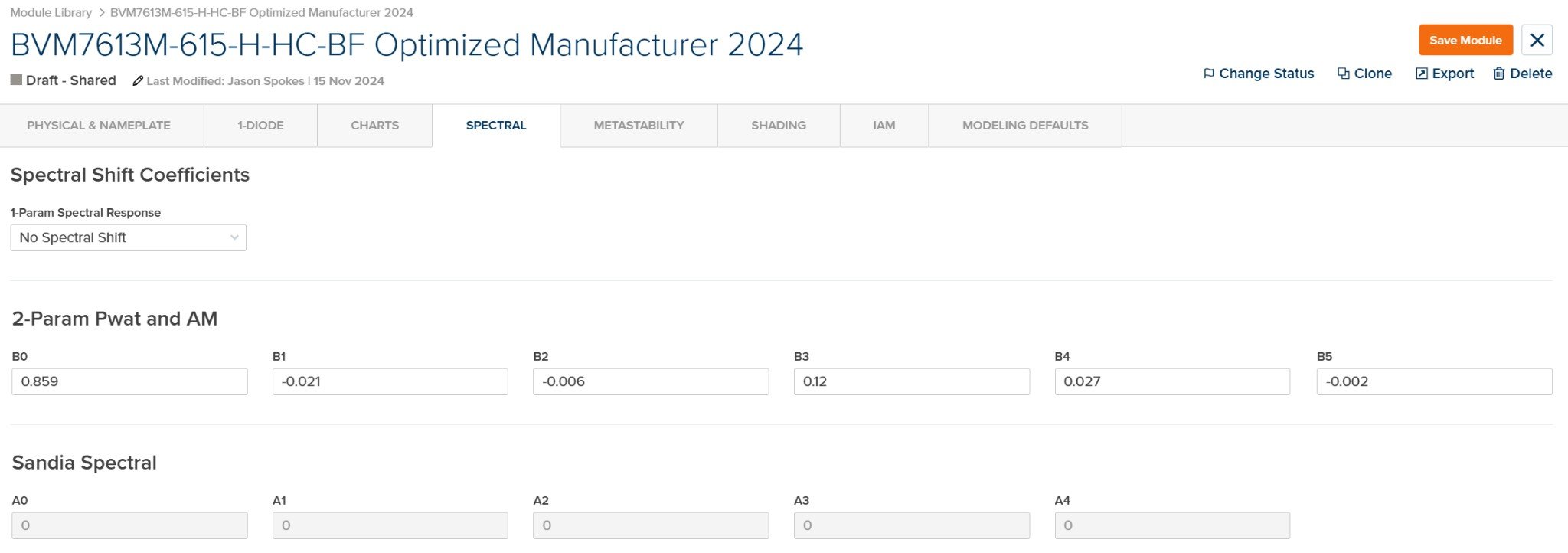
Module File Spectral

Module File - Spectral Tab

Spectral Shift Coefficients

ParameterUnitsDescription
1-Param Spectral ResponseSpectral shift model selection. Options: No Spectral Shift, FS Series 4 & Earlier, FS Series 4-2 & Earlier, Sandia

2-Param Pwat and AM

ParameterUnitsDescription
B0 – B5Polynomial coefficients for 2-parameter spectral model using precipitable water and air mass

Sandia Spectral

ParameterUnitsDescription
A0 – A4Sandia spectral correction coefficients
See Spectral Models for detailed algorithm documentation.

Metastability Tab

Experimental Feature — Terabase Energy OnlyThe Metastability tab is an experimental feature currently accessible only to Terabase Energy users. This tab contains parameters for modeling metastability effects in certain module technologies (e.g., HJT modules with light-induced annealing behavior).
See Metastability Model for technical background.

Shading Tab

The Shading tab configures how the module responds to partial shading conditions.

Module File Shading

Module File - Shading Tab

Shading Response

ParameterUnitsDescription
Module Shading ResponseShading model selection. Options: None, Linear, Fractional Electrical Shading
Fractional Shading %%Fractional electrical impact per unit of shaded area (100% = fully proportional)
See Electrical Shading for detailed algorithm documentation.

IAM Tab

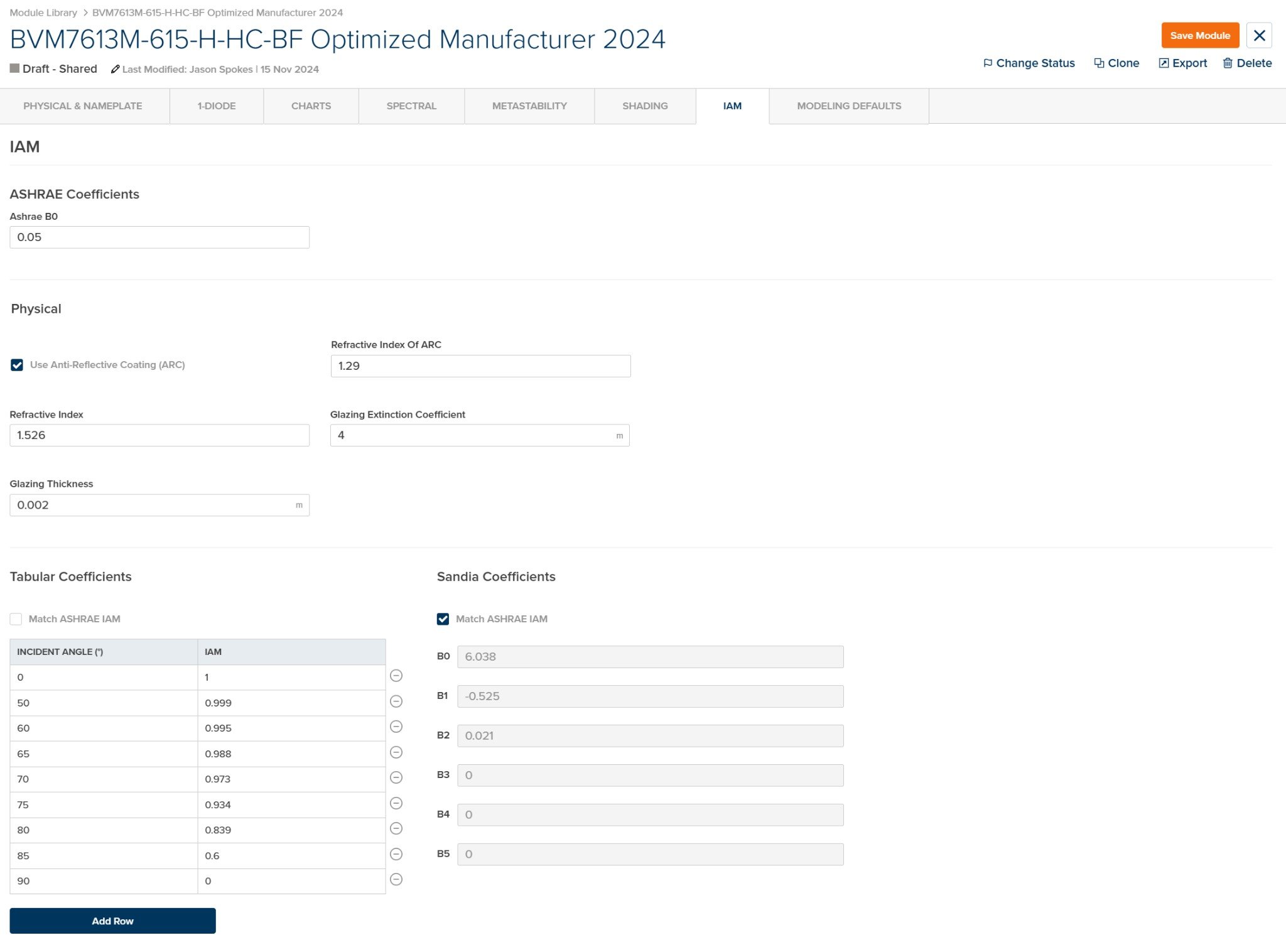
The IAM (Incidence Angle Modifier) tab contains coefficients for modeling optical losses at non-normal angles of incidence.
Module File IAM

Module File - IAM Tab

ASHRAE Coefficients

ParameterUnitsDescription
Ashrae B0ASHRAE incidence angle modifier coefficient

Physical

ParameterUnitsDescription
Use Anti-Reflective Coating (ARC)Enable physical IAM model with ARC
Refractive Index Of ARCRefractive index of anti-reflective coating
Refractive IndexRefractive index of cover glass
Glazing Extinction Coefficientm⁻¹Extinction coefficient of cover glass
Glazing Thicknessm / ftThickness of cover glass

Tabular Coefficients

ParameterUnitsDescription
Match ASHRAE IAMGenerate tabular values from ASHRAE coefficient
Incident Angle / IAM Table°, —User-defined angle-IAM pairs

Sandia Coefficients

ParameterUnitsDescription
Match ASHRAE IAMGenerate Sandia coefficients from ASHRAE
B0 – B5Sandia polynomial IAM coefficients
See Incidence Angle Modifier for detailed algorithm documentation.

Modeling Defaults Tab

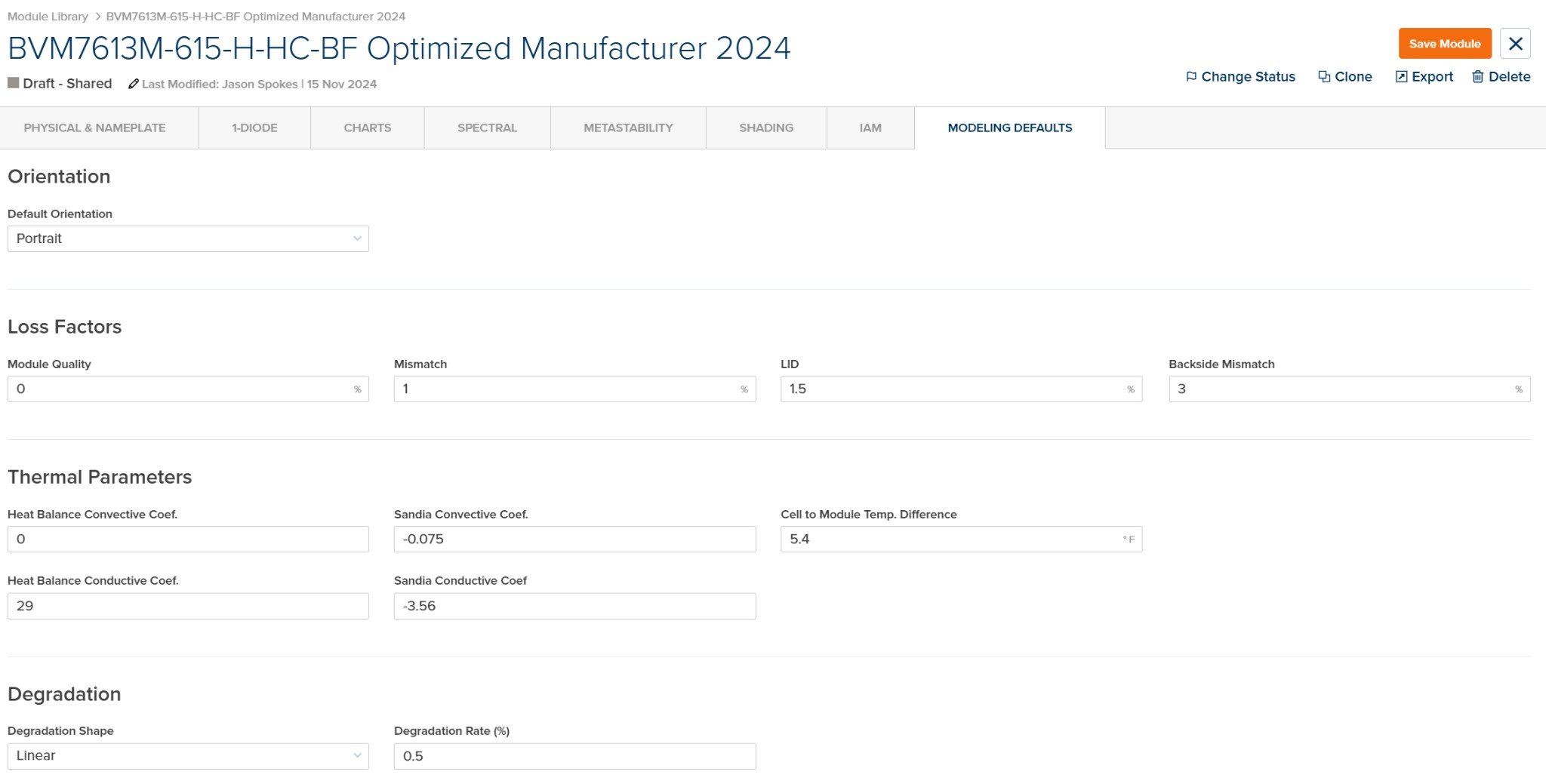
The Modeling Defaults tab contains default values for loss factors, thermal parameters, and degradation that are applied when this module is used in a prediction.
Module File Modeling Defaults

Module File - Modeling Defaults Tab

Orientation

ParameterUnitsDescription
Default OrientationDefault module orientation when added to a prediction. Options: Portrait, Landscape

Loss Factors

ParameterUnitsDescription
Module Quality%Power loss due to module quality variance from nameplate
Mismatch%Power loss due to current mismatch between modules
LID%Light-Induced Degradation loss (first-year)
Backside Mismatch%Mismatch loss for rear-side irradiance (bifacial only)

Thermal Parameters

ParameterUnitsDescription
Heat Balance Convective Coef.Convective heat transfer coefficient for heat balance model
Sandia Convective Coef.Convective coefficient for Sandia thermal model
Cell to Module Temp. Difference°C / °FTemperature difference between cell and module back surface
Heat Balance Conductive Coef.Conductive heat transfer coefficient for heat balance model
Sandia Conductive Coef.Conductive coefficient for Sandia thermal model

Degradation

ParameterUnitsDescription
Degradation ShapeDegradation curve shape over time. Options: Unspecified, Linear, Non-Linear
Degradation Rate%/yearAnnual degradation rate
Modeling Defaults can be overridden at the DC Field level within a prediction. These values serve as starting defaults when the module is first added to a design.
See Module Temperature Models for thermal parameter documentation.