Summary

The maximum AC power PAC,deratedP_{AC,derated} sets the upper bound for the operating region logic, determining the threshold. The AC power setpoint PAC,setP_{AC,set} is defined in the inverter configuration from the nameplate rating and the design derate factor. Alternatively, the setpoint or the derate factor can be set per timestep using a user-uploaded time series. When manufacturer derate curves are provided, the setpoint may be further reduced depending on ambient temperature and site elevation.

Inputs

NameSymbolUnitsDescription
Rated AC PowerPAC,ratedP_{AC,rated}kVAInverter nameplate AC power rating
Design DerateddFractional multiplier on rated power (0 to 1)
AC Power SetpointPAC,setP_{AC,set}kVAEffective AC power limit
AltitudehhmElevation above sea level
Ambient Air TemperatureTaT_a°CAmbient air temperature
Inverter Derate CurvesPAC,derate,hk(Tj)P_{AC,derate,h_k}(T_j)°C, kVATemperature-power data points at rated elevations hkh_k

Outputs

NameSymbolUnitsDescription
Temperature-Corrected Max PowerPAC,deratedP_{AC,derated}WDerated AC power capacity

Detailed Description

Setpoint Determination

The AC power setpoint is the baseline upper bound on inverter output. It is derived from the inverter nameplate rating and the user-configured design derate: PAC,set=d×PAC,ratedP_{AC,set} = d \times P_{AC,rated} A design derate of d=1.0d = 1.0 uses the full nameplate; lower values curtail the inverter (e.g., d=0.95d = 0.95 limits output to 95% of rated capacity). The user can set either the design derate dd or the absolute setpoint PAC,setP_{AC,set}; the other value is adjusted automatically to satisfy the equation above. Both values can also be overridden on a per-timestep basis by uploading a time series. A setpoint time series provides PAC,setP_{AC,set} directly in kVA, while a derate time series provides dd as a ratio (0 to 1). If both are configured, the setpoint time series takes priority.

Curve Selection by Elevation

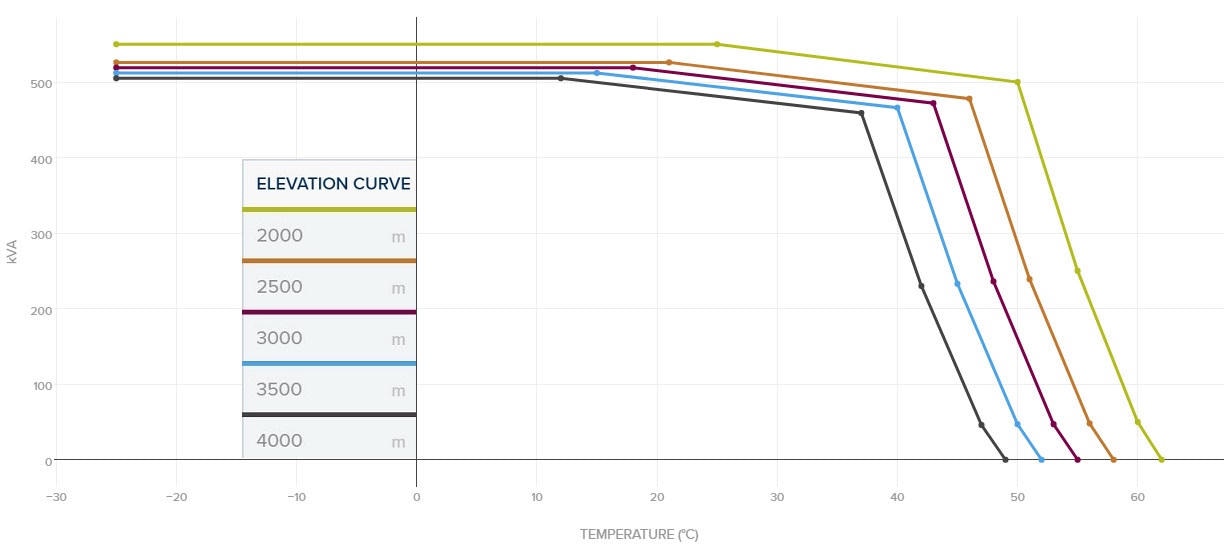
Example Inverter Temperature / Elevation Derate Curve
Inverter manufacturers may provide multiple derate curves at different elevation ratings h1<h2<<hKh_1 < h_2 < \cdots < h_K. If these curves are available, PlantPredict selects the curve whose elevation is the smallest value still strictly above the site altitude: h=min{hk:hk>h}h^* = \min \{ h_k : h_k > h \} If the site altitude exceeds all available curve elevations (h>hKh > h_K), the highest curve is used: h=hKh^* = h_K

Temperature Interpolation

Once the curve PAC,derate,hP_{AC,derate,h^*} is selected, the ambient temperature TaT_a is linearly interpolated against its data points to obtain PAC,derate,h(Ta)P_{AC,derate,h^*}(T_a). If TaT_a falls outside the curve’s temperature range, the inverter is derated to zero (PAC,derated=0P_{AC,derated} = 0).

Final Output

The final AC power limit is the lesser of the setpoint and the temperature-derated capacity: PAC,derated=min(PAC,set,PAC,derate,h(Ta))P_{AC,derated} = \min\bigl(P_{AC,set},\, P_{AC,derate,h^*}(T_a)\bigr) The prediction engine converts PAC,deratedP_{AC,derated} from kVA to W (×1000\times\,1000) before passing it to the inverter operating region logic. When derate curves are not enabled, the temperature derating step is skipped and PAC,derated=PAC,setP_{AC,derated} = P_{AC,set}.